
A device-centered approach improves equipment efficiency to deliver the same output with less power.
It relies on electronic ballasts or high-efficiency motors, but has technical limits.
A system-centered approach adjusts voltage and current to match changing load demand, supplying only what is needed.
It reduces waste by aligning power delivery with real-world operating conditions.
In general, power-saving technology has developed along these two directions. Our solution follows the second approach: by analyzing load variations and characteristics, it controls unnecessary voltage and current, supplies the appropriate electrical energy to the load, corrects phase imbalance, and improves motor efficiency and power factor—reducing electricity use while extending equipment lifespan.

The mutual-induction-reactor power-saving device uses simultaneous voltage and current
control. By reducing voltage to an appropriate level based on load type and load factor,
it induces mutual induction to achieve power savings. This product holds a patented principle
(Patent No. 10-1059525).

Mutual induction between the voltage coil (n1) and current coil (n2) generates feedback current
(n2/n1) that supports the load, reducing input current accordingly.
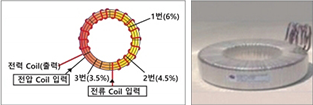
· Opposite coil windings.
· Each tap has different turns.
· Secondary input: primary end.
The reactor consists of a primary voltage coil and a secondary current coil wound on a toroidal core.
The primary coil includes voltage adjustment taps (TAPs), while the secondary coil is rated for the
specified current and wound in the opposite direction. The ends of the voltage coil and current coil are
connected in series so the unit functions as a series reactor.
When the adjusted (reduced) voltage is applied to the primary coil and current flows in the reverse
direction through the secondary side, mutual induction induces current in the voltage coil. The increased
current is then supplied to the secondary current coil side. As a result, the output current to the load
increases by the added feedback current, while the input current decreases. This is the basic principle of
the mutual-induction-reactor power-saving device.
Savings generally increase as the voltage reduction level increases; however, the reduction level must be
set and operated appropriately depending on reactor efficiency and load conditions.
SAVUS, a mutual-induction-reactor power-saving device, also provides the benefits of a series reactor,
improving power factor and efficiency. For induction motors, it is designed to help balance three-phase
power, creating a synergistic effect that enhances energy savings.
In particular, our power-saving device uses a high-efficiency mutual induction reactor developed and
manufactured in-house. With reactor efficiency of 99.95% or higher, the device’s self-consumption is
low, quality control is unified, and the product is designed for long-term, durable operation.
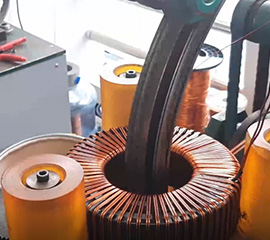
Toroidal core coil winding
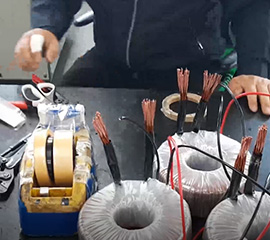
Excitation winding setup
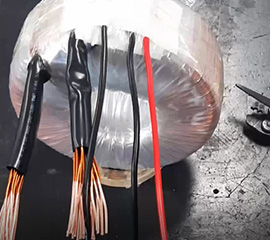
Tap grounding
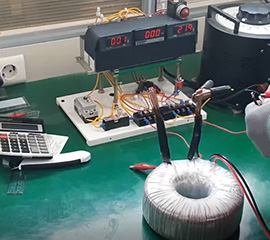
Reactor inspection

Electrical equipment is designed to operate within a specified voltage range.
For motors under 22 kW, higher voltage can increase excitation current, reduce efficiency,
and raise temperature—especially in motors under 2.2 kW.
Under KEPCO standards: 220 V → 207–233 V (±13 V), 380 V → 342–418 V (±38 V).

When KEPCO supplies electricity to customers, the voltage maintenance range by
standard voltage is as follows, and the standard frequency is 60 Hz.

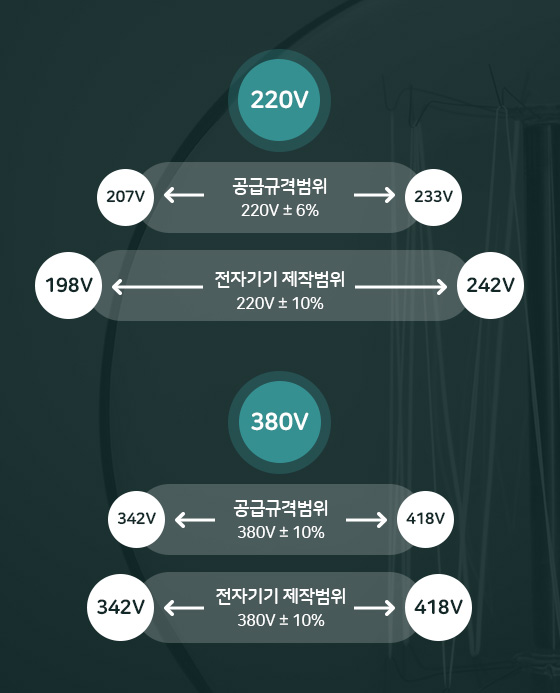


Grid spec
220V ± 6%


Device spec
220V ± 10%


Grid spec
380V ± 10%
Device spec
380V ± 10%



Reduced output and RPM
Increased copper losses, reducing motor efficiency
Voltage balance is key to savings and equipment life.